
Costing an East Asian Scent Range for a Store Listing
The cost of an East Asian scent is decided by a handful of choices, and almost none of them are the material list itself. Concentration, pack weight, decoration and order quantity move the unit cost far more than swapping one floral for another, which is why two quotes for a similar brief can differ by half. Reading a quote as a set of buckets, rather than as a single number, is what makes the difference explainable and negotiable.
Key takeaways
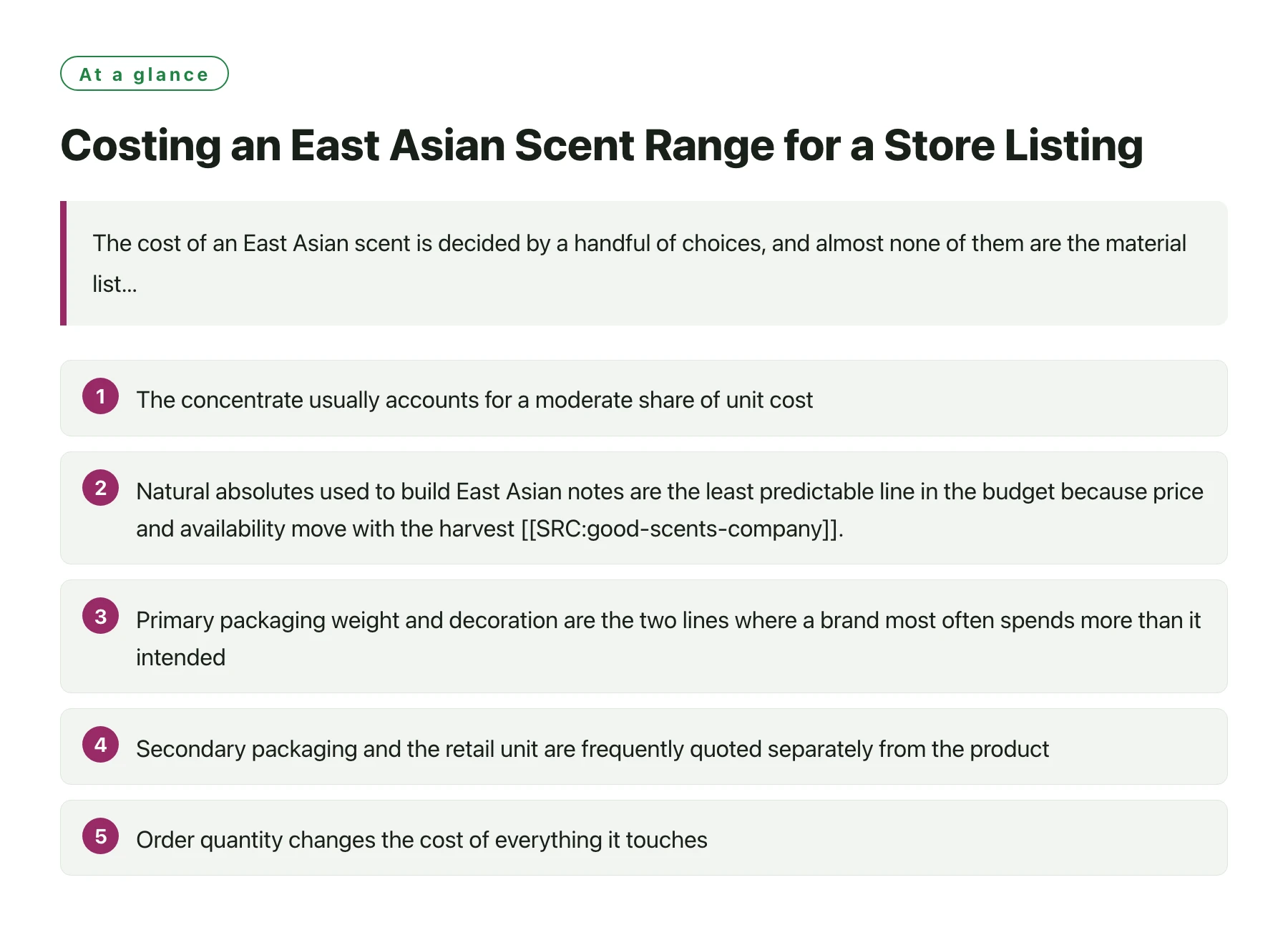
- The concentrate usually accounts for a moderate share of unit cost; dosage and pack weight typically move the number more than the choice of floral material.
- Natural absolutes used to build East Asian notes are the least predictable line in the budget because price and availability move with the harvest [1].
- Primary packaging weight and decoration are the two lines where a brand most often spends more than it intended, because both are decided late and priced per piece.
- Secondary packaging and the retail unit are frequently quoted separately from the product, which is why a quote can look complete and still leave a third of the cost unaccounted for [2].
- Order quantity changes the cost of everything it touches, so a quote is only comparable against another quote at the same quantity and the same scope.
Cost conversations about East Asian materials often start in the wrong place. A buyer asks what an osmanthus or a tea absolute costs, receives a figure per kilogram, and assumes that the answer decides the retail price. In practice, a material at a high price per kilogram can contribute little to a unit cost if it is used sparingly, while a modest material dosed heavily in a large bottle dominates the budget.
The useful way to model a range is therefore top-down as well as bottom-up. Start with the retail price the store will accept, subtract the margin the channel requires, then the freight, duty and packaging, and see what remains for the product. That residual is the real constraint, and it is far more useful than a material price list.
The buckets below are the ones that appear in a professional quote. Knowing what sits in each one, and who controls it, is what turns a cost discussion into a decision.
The eight buckets in a fragrance unit cost
| Bucket | What it contains | What actually moves it |
|---|---|---|
| Fragrance concentrate | The compounded oil, whether built from naturals, reconstructions or a blend of both | Dosage in the finished product, the cost of the dominant materials, and whether the formula is exclusive or drawn from a library [1] |
| Solvent and compounding | The alcohol or carrier, plus the labour and energy of compounding and maceration | The grade of solvent, market rules on denaturation, and resting time built into the schedule |
| Primary pack | Glass, pump, collar and cap, including any custom moulding | Whether the components are stock or bespoke, the glass weight, and the tolerance class the brand accepts |
| Decoration | Coating, screen print, hot foil, frosting and any applied emblem | Number of passes, reject rate at volume, and whether tooling is amortised into the price or billed once |
| Secondary packaging | Carton, rigid box, insert, leaflet and any retail-ready outer | Material choice, print processes, and whether a tester or counter unit is included |
| Testing and documents | Stability and compatibility work, safety inputs and the paperwork that travels with the goods | How many pack and product combinations are tested, and whether testing is repeated after a formula change |
| Freight and duty | Transport, insurance, customs handling and destination charges | Bottle weight and box volume, destination rules, and how the shipment is consolidated |
| Order quantity | The amortisation of every setup, minimum and tooling cost above | Whether material minimums are met, and how many units the run is spread across |
Two habits make this table useful. The first is to ask each supplier to break the price into these buckets rather than presenting a single figure, then to compare bucket by bucket instead of total against total. The second is to keep one page of assumptions, quantity and scope attached to every quote, because a comparison between two quotes built on different assumptions is not a comparison at all. Buyers who want a worked example of how those lines are read can find one in any careful explanation of where a perfume quote can hide costs, and it is worth reading before the first quote arrives rather than after.
Where a lower quote moves cost rather than removing it
A quote that comes in materially below the others is not automatically suspect, but the difference has to sit somewhere. In practice it usually sits in one of five places, and knowing which one tells you what you are agreeing to.
The first is dosage. A formula can be made cheaper by reducing the concentrate, and the result is a scent that opens brightly in the sample and fades within the hour. The second is glass. Lighter bottles reduce freight and material cost together, and a department store customer is more likely to notice the difference than a buyer expects.
Decoration passes and packaging scope
Decoration is often where scope quietly narrows. A quote may include one print pass where the design needs two, or standard frosting instead of the acid-etched finish shown in the reference. Both are legitimate options; the problem is comparing prices between configurations that are not the same.
Secondary packaging follows the same pattern. Cartons and counter units are quoted separately in many projects, so a brand that compares product-only prices can find the remaining cost arriving later, at a point when the launch budget is already committed. European packaging rules are also pushing material and weight decisions into the cost model earlier than before, which makes this bucket worth reading closely rather than treating as an afterthought [2].
Testing, documents and the cost of finding out late
Testing is a small line in most quotes and a large one in most failures. When it is trimmed, the saving is usually in the number of combinations tested: one product in one pack rather than the same scent in the pack the store will sell. The cost reappears later as a reformulation or a rejected batch.
The same logic applies to documentation. A quote that assumes the brand already holds its safety inputs is cheaper than one that includes generating them, and both are valid structures. What matters is that the assumption is written down, so nobody assumes the other party has it.
Why quantity dominates every other lever
A single line about volume changes the price of glass, cartons, decoration and materials at once, because each of those comes with a minimum and a setup. This is why a brand comparing a 3,000-piece quote with a 10,000-piece quote is not comparing suppliers at all; it is comparing two different projects.
The practical consequence for a department store launch is that the first order is often not the cheapest order and should not be treated as the benchmark for the programme. Negotiating the trajectory, rather than only the opening price, is where most of the value sits.
Reading a quote against the price ladder
Unit cost means different things at different points in the chain, and a large share of budget confusion comes from mixing them. The factory price, the landed cost and the retail price are three separate numbers, and the gap between them is not margin alone.
Landed cost includes freight, insurance, duty, customs handling and any compliance fee, and it is the number a brand should actually plan against. For a heavy glass pack travelling a long distance, the gap between the two can be large enough to change a packaging decision. Premium positioning also changes how much of that gap a customer will tolerate, and public commentary from consumer research publishers on the premium segment is a reasonable sanity check on that assumption rather than a substitute for your own margin model [3].
The final check is consistency: the same quantity, the same scope and the same destination for every quote in the comparison sheet. Anything else produces a ranking that will not survive contact with the first purchase order.
If only two lines can be negotiated, negotiate the ones that touch everything else: quantity, and the packaging configuration. Concentrate cost is real but bounded, while packaging and volume decide the price of glass, cartons, decoration and freight together. A manufacturer that shows its material palette openly, as at www.xuelei.com/, makes the concentrate part of the conversation easier to audit, and a partner used to high-end perfume production will generally arrive with the packaging assumptions already separated from the product price, which is the sign of a quote that can be compared. Buyers who want the fuller version of this analysis, including how wholesale programmes are costed across a range rather than a single item, can read up on cost drivers in custom fragrance wholesale.
Sources
- The Good Scents Company —— A reference database of aroma materials with odour descriptions, CAS numbers and typical usage information.
- European Commission: Packaging Waste and the PPWR —— EU rules on packaging and packaging waste, including the Packaging and Packaging Waste Regulation requirements on recyclability and design.
- Mintel Press Centre —— Mintel's press releases on consumer and beauty market research, including fragrance and personal care trend reporting.
Frequently asked questions
Why do two factories quote very different prices for the same brief?
Usually because the quotes are not for the same thing. Dosage, glass weight, number of decoration passes, packaging scope, testing extent and order quantity can all differ while the brief stays the same on paper. Ask for the buckets rather than the total, and compare like for like.
Do East Asian materials make a formula more expensive?
Some natural absolutes are costly and their availability moves with the harvest, but their contribution depends on dosage. In many formulas the dominant cost comes from materials used in volume rather than from the most distinctive note, so the answer depends on the whole construction.
Should the first order be the largest one?
It is usually better to place a smaller first order that tests the market, and to negotiate the price trajectory for subsequent orders rather than trying to reach the best unit price immediately. Committing to a large first run to reach a price tier carries inventory risk that is rarely worth the saving.
What should be included in a landed cost model?
The factory price, freight and insurance, duty and customs handling, any compliance or testing fees, and the cost of the packaging that travels with the goods. If the brand also pays for testing, artwork or a retail-ready counter unit, those belong in the model too, or the launch budget will be short.
How much testing should a first range budget for?
Enough to cover each product and pack combination the store will sell, plus a margin for one reformulation. Treating testing as a contingency rather than a line item is the most common way a modest saving during quoting turns into a significant cost during the launch.
The smartest minute in New York, in your inbox.
Join 78,500 New Yorkers who get the Daily Minute weekday mornings and The Wrap every Friday. Free, fast, and fiercely local.
Subscribe to the Daily Minute