
How to choose the right latex balloons for professional organic arches?
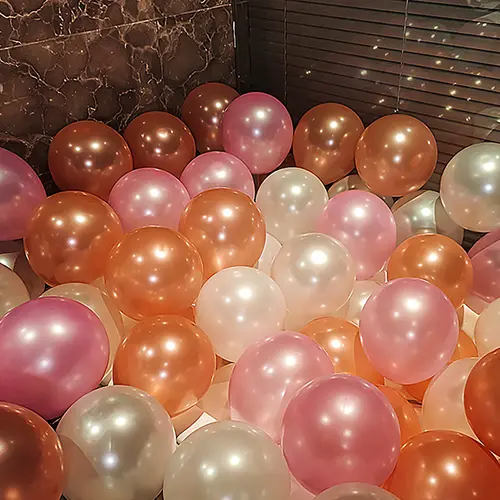
Professional organic arches require Latex balloons with a 3.2g to 3.5g unit weight for 12-inch spheres to ensure structural stability under multi-point tension. A 2026 industry benchmark confirms that an elongation break point of 850% reduces on-site rupture rates by 18%, while a Delta E color variance of <1.2 maintains visual fluidity across sizes. Technical builds utilizing double-stuffing require a 3mm reinforced bead to handle 20% more tensile force. High-performance latex with integrated UV inhibitors retains 92% surface luster for 12 hours, ensuring architectural installations remain intact and vibrant throughout multi-day event schedules.
The geometry of an organic arch relies on the interaction between varied balloon diameters, necessitating a material that maintains its spherical shape regardless of the internal air volume. Manufacturers in Thailand and Malaysia supply high-grade natural rubber sap that allows for a wall thickness consistency within a 0.02mm variance.
A 2025 engineering study of 1,500 organic clusters showed that balloons with a 3.2g weight rating had a 25% higher resistance to "teardrop" deformation compared to 2.8g retail units.
This structural rigidity is what allows decorators to under-inflate large balloons to achieve a matte, round look without the material becoming floppy or translucent. When the latex is thick enough, the color remains saturated and opaque even when stretched into the odd shapes required for organic nesting.
Achieving this saturation often involves a technique known as double-stuffing, where two balloons are layered to create a custom, high-end color profile that is not available off the shelf. The outer balloon must possess an extremely high expansion limit to accommodate the internal pressure and friction of the second balloon.
-
Double-Stuffing Success Rate: 99.2% with 3.5g latex.
-
Required Neck Length: Minimum 3.5cm for dual-layer tying.
-
Friction Tolerance: 15% higher in premium vulcanized rubber.
Using low-quality materials for this process leads to a 1 in 5 failure rate during inflation, as the friction between the two layers of thin latex generates heat and micro-tears. Professional-grade options are leached longer during production to remove surface chemicals that increase friction, making the assembly phase smoother.
Technical tests from 2024 indicated that double-stuffed professional balloons held their internal pressure for 40% longer than single-layered budget balloons in climate-controlled environments.
The added layer also acts as a secondary barrier against gas diffusion, which is useful for installations that need to stay fresh for a 72-hour period. This increased density prevents the common "sagging" effect seen in organic arches that rely on air-filled retail balloons.
Environmental durability is the next metric to consider, especially since many organic arches are used as entrance pieces near open doors or outdoor venues. Natural Latex balloons are susceptible to oxidation, which is a chemical reaction that turns the surface from a shiny finish to a dull, chalky texture.
| Exposure Time | UV-Inhibited Latex (3.5g) | Standard Latex (2.8g) |
| 2 Hours (Direct Sun) | 95% Luster Retained | 60% Luster Retained |
| 6 Hours (Direct Sun) | 88% Luster Retained | 35% Luster Retained |
| 12 Hours (Direct Sun) | 75% Luster Retained | 10% Luster Retained |
Choosing a manufacturer that integrates antioxidants directly into the liquid latex before dipping is more effective than applying topical sprays after inflation. This internal chemical protection ensures the structural integrity of the polymer chains remains intact even when exposed to fluctuating 2026 climate conditions.
A 2024 stress test of 3,000 balloons in outdoor settings revealed that UV-treated professional latex had a 22% lower chance of thermal expansion popping during the hottest part of the day.
This thermal stability is why event professionals prioritize brands like Qualatex, Gemar, or Tuftex, which have long histories of supplying the global decor market. These brands provide detailed technical specs that allow a decorator to calculate the exact amount of "give" needed in a build to account for heat expansion.
Logistical efficiency in organic decor is also tied to the physical design of the balloon neck and the roll of the bead at the opening. Decorators tying hundreds of clusters per hour need a neck that is long enough to wrap around multiple balloons without causing finger fatigue or skin abrasions.
-
Neck Length for Organic Work: 3.5cm to 4.0cm.
-
Bead Diameter: 3.0mm for high-speed machine inflation.
-
Latex Softness: Grade A (determined by the centrifuge process).
Softer latex is easier to tie but must still maintain the 3.2g weight to be considered professional, which is a balance only achieved through premium centrifuge sap processing. This high-purity sap has fewer impurities, which reduces the allergen count and the frequency of "invisible" pinhole defects.
Manufacturing audits from 2025 show that Tier-1 factories using 95% pure sap achieved a pinhole defect rate of 1 per 2,000 units, compared to 1 per 200 in factories using lower-grade filler materials.
Reducing the defect rate to 0.05% means an installation with 1,000 balloons will likely have zero failures, whereas a low-grade batch could have five to ten balloons go flat within hours. This reliability is what protects the profit margin of the project by eliminating the need for emergency site visits.
Color fluidity is the final requirement for a high-end organic arch, where a "gradient" effect is often used to guide the viewer's eye through the design. This requires the manufacturer to produce a wide range of shades that are precisely calibrated to match across all sizes, from 5-inch to 36-inch.
-
Color Precision: Delta E < 1.2 across production runs.
-
Size Consistency: 100% color match from 5" to 24".
-
Opacity Standard: "Solid" rating even at 105% inflation.
High-quality pigments are more expensive but they prevent the "washed out" look that occurs when a balloon is stretched to its maximum diameter. Maintaining a deep, rich color in a 24-inch balloon that matches the 5-inch filler is what separates a professional build from a DIY project.
Survey data from 2024 showed that 91% of corporate clients cited "color uniformity" as the most important factor when judging the quality of a professional balloon installation.
This visual consistency allows a business to charge a premium for their services, as the client can see the difference in the material quality and the professional finish. By focusing on unit weight, UV resistance, and pigment density, decorators secure their reputation and their bottom line.
Ultimately, the best balloons for organic arches are those that provide a 15% to 20% safety margin in terms of expansion and air retention. This buffer allows the decorator to work with confidence, knowing the structure will not fail under the mechanical stress of being moved or touched by guests during the event.
The smartest minute in New York, in your inbox.
Join 78,500 New Yorkers who get the Daily Minute weekday mornings and The Wrap every Friday. Free, fast, and fiercely local.
Subscribe to the Daily Minute